
Automatic lubrication systems keep mining and heavy industrial assets moving. They pump grease through trunk lines, fire injectors, and cycle on schedule. But here is the problem most maintenance teams eventually discover: pump pressure does not confirm that grease actually reached the bearing. A blocked injector, a bypassing injector, a blown hose downstream, or an empty tank can all starve a critical pin or bush while the system reports normal pressure. The gap between assumed lubrication and verified lubrication is where catastrophic failures hide.
This guide walks you through the selection criteria, failure modes, and monitoring methods that separate effective automatic lubrication monitoring systems from traditional setups that leave your maintenance team guessing. GreaseBoss provides the framework for digital grease verification, comparing planned vs actual delivery at every monitored point.
Key Takeaways: Auto-Lube Monitoring Systems
- Pump pressure alone does not confirm grease reached the bearing, injector, or pin that needs it.
- Common auto-lube failures include blocked injectors, bypassing injectors, blown hoses, and empty grease tanks.
- Point-of-delivery monitoring measures the exact grease volume passing through each critical lubrication point.
- GreaseBoss Critical Point Monitoring verifies planned vs actual grease delivery every pump cycle, with automatic alerts.
- Fleet-wide visibility turns reactive bearing replacements into targeted, prescriptive maintenance before failures occur.
What Is an Automatic Lubrication Monitoring System?
An automatic lubrication monitoring system is a combination of sensors, connectivity hardware, and cloud software that tracks the performance of your automatic lubrication system in near real-time. Rather than relying on periodic visual checks or pump pressure indicators, a monitoring system records what is happening at the point where grease is delivered.
Traditional auto-lube setups include a pump, reservoir, trunk lines, and injectors. They deliver grease on a timed schedule. A monitoring layer sits on top of that existing infrastructure, measuring grease volume, flow patterns, and system health, then reporting this data back to your maintenance team.
The distinction matters. An auto-lube system delivers grease. A monitoring system verifies that the grease arrived where it was supposed to, in the correct quantity. One without the other leaves your operation exposed.
Why Mining and Heavy Industrial Operations Need Lubrication Monitoring
Mining and heavy industrial environments put extreme stress on lubrication systems. Dust, vibration, high loads, and temperature swings accelerate component wear. According to Caterpillar, insufficient lubrication is the number one cause of pin and bush failures on heavy mobile equipment. Shell PLC data indicates that 70% of mechanical failures are linked to incorrect lubrication.
A single grease-related failure on a haul truck or excavator can cost a quarter of a million dollars in direct repairs, and far more once lost production is counted. A seized excavator pin that needs line boring can mean two weeks of downtime. A 2025 Plant Services report highlights how innovations in lubrication software and sensor technology are adding intelligence to lubrication programmes across heavy industry.
Without monitoring, your maintenance team has no way to know whether each grease point received the right volume at the right time. The auto-lube system runs. The pump reaches pressure. Everyone assumes the machine is greased. That assumption is where silent failures begin.
How Automatic Lubrication Systems Fail
Understanding the specific ways auto-lube systems fail is the first step toward selecting the right monitoring approach. These are not vague “equipment issues.” They are named, documented fault modes that your monitoring system needs to detect.
Blocked Injectors
Grease solidifies or contaminants accumulate inside the injector, preventing it from firing. The pump continues to build pressure, but no grease passes through to the bearing. Traditional pressure-based monitoring will not flag this fault because system pressure appears normal.
Bypassing Injectors
An injector fails in the open position, allowing grease to pass through without metering. The affected point may receive too much or too little grease, and adjacent points on the same circuit can be starved. This failure mode often goes undetected for weeks or months.
Blown Hoses Downstream of Injectors
Vibration, heat, and mechanical contact can rupture hoses between the injector and the bearing. Grease exits the system before reaching the lubrication point. Pressure in the trunk line may still read as normal because grease is flowing, just not to where it needs to go.
Venting Issues and Incorrect Pump Configuration
If the pump timer is set incorrectly or the vent cycle is disrupted, the system may under-deliver on every cycle. Over time, this results in chronic under-greasing across multiple points. Without volume verification at the point of delivery, the shortfall stays invisible.
Empty or Partly Filled Grease Tanks
Tank filling is often manual and rarely verified. When a tank runs empty, the pump can cycle on air and no grease is delivered anywhere in the system. Even when a pressure alert fires, it does not tell your team why, so they end up fault-finding the whole system.
The Core Problem: Pump Pressure Does Not Equal Grease Delivery
This is the single most important concept in auto-lube monitoring. Most traditional systems monitor pump pressure. When the pump reaches its target pressure, the system registers a successful cycle. But pump pressure only tells you that the pump pushed grease into the trunk line. It tells you nothing about what happened downstream.
A system with three blocked injectors and two blown hoses can still reach target pressure. The pump does not know the difference. Your maintenance team does not know the difference either, until a seized pin or a failed bearing appears on the repair schedule.
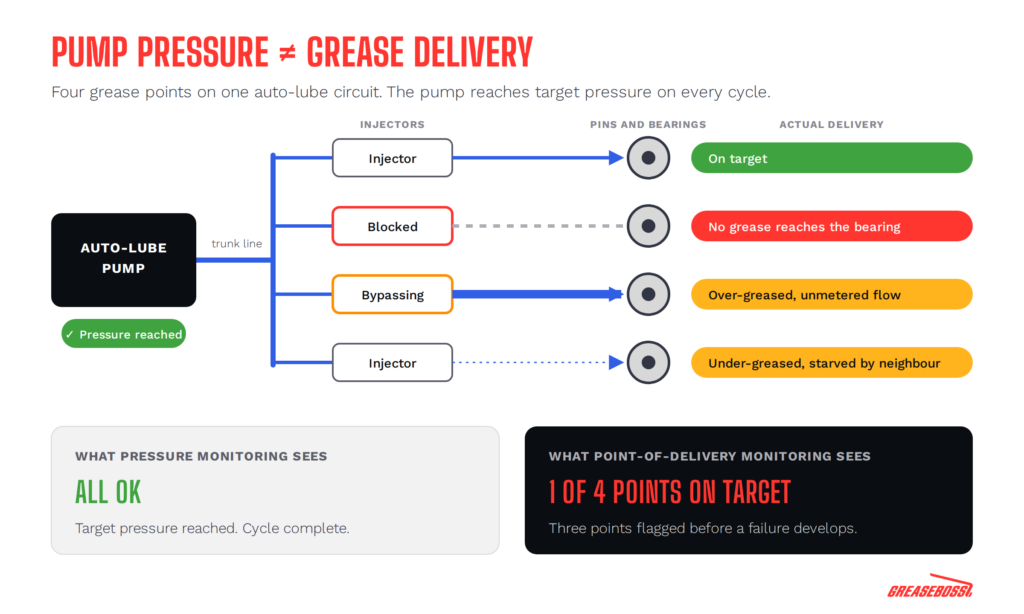
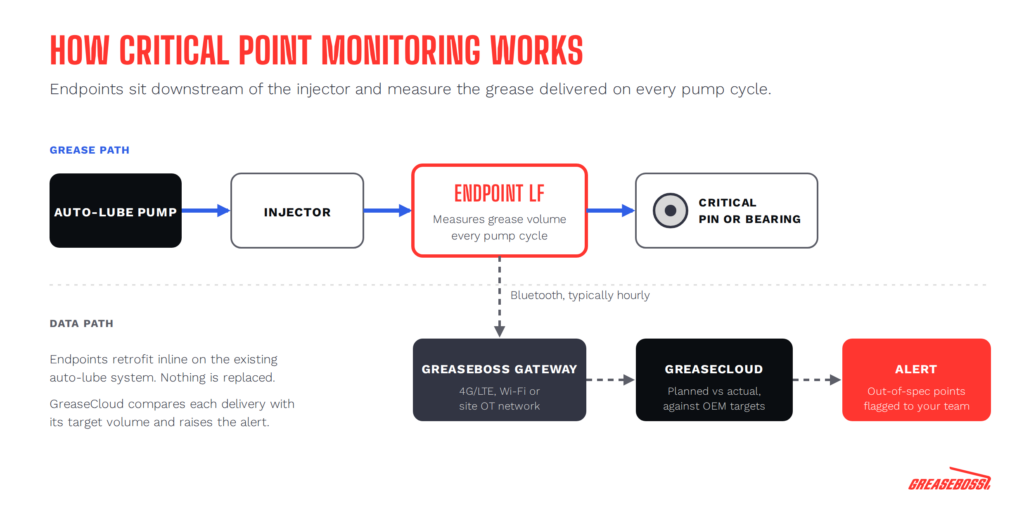
Effective monitoring must measure grease volume at or near the point of delivery. That is the only way to confirm that the right grease arrived, in the right amount, at the right time. GreaseBoss built its entire Critical Point Monitoring solution around this principle. Endpoints installed downstream of the injector record the exact volume of grease that passes through each monitored point every pump cycle.
What to Look for in an Automatic Lubrication Monitoring System
Not all monitoring approaches deliver the same level of visibility. When evaluating systems for your mining or industrial operation, these are the criteria that matter most.
Point-of-Delivery Grease Verification
The system must measure grease volume at or downstream of the injector, not at the pump. Volume measurement at the point of delivery confirms that grease passed through the injector and on towards the bearing. Anything less than point-of-delivery verification leaves gaps in your data.
Planned vs Actual Comparison
Your monitoring platform should compare the volume of grease delivered against the volume specified by the OEM or your engineering team. This planned vs actual comparison highlights under-greased points, over-greased points, and deviations from specification before they become failures. GreaseCloud automates this comparison and triggers alerts when delivery falls outside the target range.
System-Wide Fault Detection
When multiple points on one auto-lube circuit are monitored, the data reveals patterns. A bypassing injector on a non-critical point changes flow distribution across the entire system, affecting critical points as well. Your monitoring system should detect these abnormal patterns and alert your team, not just monitor individual endpoints in isolation.
Automatic Alerting and Prescriptive Maintenance
Alerts should be automatic and targeted. When grease delivery falls out of specification, the system notifies your maintenance team so they can raise a work order and schedule a fix during the next maintenance window. This is prescriptive maintenance, not reactive, and it is the difference between replacing an injector or a hose and replacing a bearing.
Connectivity and Data Backhaul
Mining and industrial sites present unique connectivity challenges. Your monitoring system needs flexible data backhaul options, including 4G/LTE SIM, site Wi-Fi, and a wired connection to the site OT network. Endpoints should communicate wirelessly (Bluetooth to a gateway, then gateway to cloud) to minimise installation complexity. The GreaseBoss Gateway supports all of these connectivity options.
Ease of Installation and Deployment Speed
Monitoring hardware should be retrofit-compatible with your existing auto-lube system. Endpoints that install in minutes rather than hours mean your maintenance team can instrument critical points without lengthy shutdowns. GreaseBoss Endpoint LF units install downstream of existing injectors and distributors, delivering actionable data within one day of installation.
Durability for Harsh Environments
Sensors deployed on haul trucks, excavators, crushers, and processing plants must withstand dust, vibration, water ingress, and temperature extremes. Look for hardware designed to IP68, with battery life measured in years rather than months. GreaseBoss Endpoint LF units are designed to IP68, operate from -40°C to 85°C, and have a battery life of 3 to 5 years. Industrial-grade construction is non-negotiable for mining applications.
Types of Auto-Lube Monitoring: A Comparison
Different monitoring approaches offer different levels of visibility. Here is how the main methods compare across the criteria that matter to maintenance and reliability teams.
| Monitoring Approach | What It Measures | Detects Blocked Injectors | Detects Blown Hoses | Confirms Delivery Volume |
|---|---|---|---|---|
| Pump Pressure Only | System pressure at the pump | No | No | No |
| Cycle Counting | Number of pump cycles completed | No | No | No |
| Progressive Divider Monitoring | Piston movement in divider blocks | Yes (entire circuit stops) | No | Partial |
| Point-of-Delivery Flow Monitoring | Exact grease volume at each point | Yes | Partial (depends on where the hose fails) | Yes |
Point-of-delivery flow monitoring provides the most complete picture. It answers the question that pressure monitoring cannot: did the grease actually reach the bearing?
How GreaseBoss Critical Point Monitoring Works
GreaseBoss designed its monitoring solution specifically for mining and heavy industrial environments where grease-related failures carry the highest consequences. The system architecture is straightforward.
Endpoint LF units are installed downstream of injectors and distributors. Each Endpoint records the exact volume of grease that passes through when the automatic lubrication pump fires. This data syncs periodically (typically every hour) to a nearby GreaseBoss Gateway via Bluetooth.
The Gateway connects to GreaseCloud through 4G/LTE, site Wi-Fi, or the site OT network. In GreaseCloud, OEM lubrication specification data serves as the target delivery volume. The system compares planned vs actual greasing and triggers automatic alerts to maintenance teams when delivery is out of specification.
On a Queensland coal mine, GreaseBoss installed 52 Endpoint LF units across two crushing trains. The day after installation, the data revealed that only 30% of grease points were being greased on target. Six months later, a failed auto-lube pump was detected by GreaseBoss data. The failure had gone unnoticed by site SCADA systems and physical inspections. Since the installation, there have been no grease-related bearing failures on that equipment. According to a 2025 whitepaper published by Noria Corporation on Machinery Lubrication, grease delivery verification is the missing link in HME reliability, and mining operations can address this vulnerability to prevent failures, reduce downtime, and improve safety.
Selecting the Right Monitoring Hardware for Your Assets
Different asset types and lubrication architectures require different sensor configurations. Here is how to match hardware to your operation.
Heavy Mobile Equipment (Excavators, Haul Trucks, Wheel Loaders)
Mobile assets experience the harshest operating conditions. Endpoint LF units install downstream of the injector at the highest-consequence points: the A-frame (nose cone) on haul trucks, and the bucket pins, boom foot, and hoist cylinders on excavators. Each Endpoint measures the grease volume delivered every pump cycle, so a blocked injector, or a point starved by a bypassing neighbour, shows up as low or zero flow. An Endpoint BF at the grease tank adds pump health and tank filling across the rest of the machine.
Fixed Plant Equipment (Crushers, Sizers, Conveyors, Mills)
Fixed plant assets often have large numbers of lubrication points served by centralised auto-lube systems. The Endpoint LF is suited to monitoring low-flow grease delivery on individual critical points across a plant. A fixed plant deployment might involve dozens of Endpoints covering multiple machines on a single GreaseCloud instance. According to a Machinery Lubrication article on flow confirmation, most centralised lubrication systems on the market do not offer a means of confirming flow to the lube point, reinforcing the need for point-of-delivery measurement.
Pump and Tank Monitoring
For sites that need visibility into overall pump performance and grease tank filling, the Endpoint BF (Bulk Flow) measures directional flow during pressurisation and venting. This shows how much grease enters the system and how much returns to the tank through the dump valve, giving you a complete picture of auto-lube pump function and whether the tank is being filled.
Step-by-Step Guide to Deploying an Auto-Lube Monitoring System
Rolling out a monitoring system does not require a lengthy capital project. A phased, practical approach gets you data and results quickly.
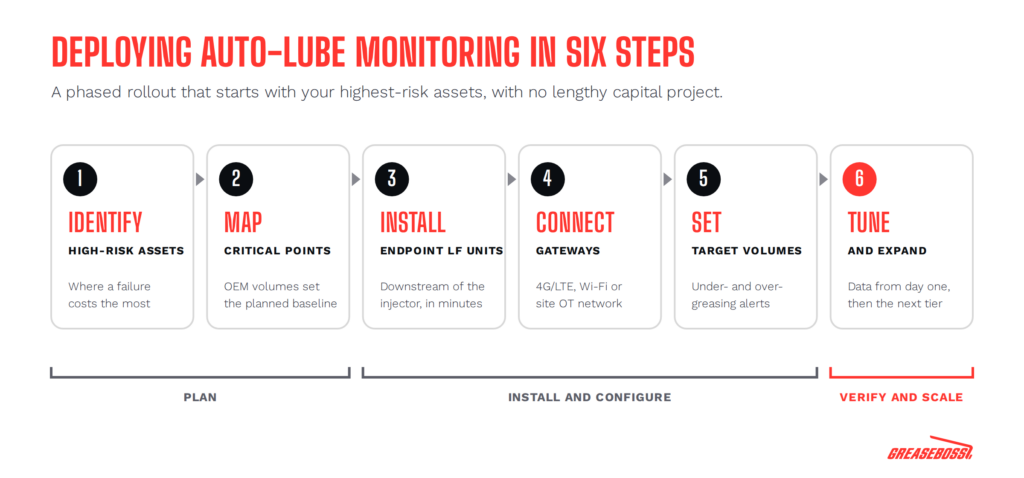
Step 1: Identify Your Highest-Risk Assets
Start with the assets where grease-related failures carry the greatest cost. On a mining site, this typically means excavator bucket pins, boom foot, and hoist cylinder areas, haul truck A-frames and steering components, and crusher or sizer bearings. Prioritise the points where a single failure costs six or seven figures in lost production.
Step 2: Map Critical Lubrication Points
For each asset, identify the specific grease points that are most vulnerable to under-lubrication. OEM documentation specifies target volumes and intervals. These specifications become your “planned” baseline in the monitoring system.
Step 3: Install Endpoints Downstream of Injectors
Mount Endpoint LF units downstream of injectors and distributors. Installation typically takes minutes per point, and each Endpoint mounts with bolts, a bracket, or a magnet.
Step 4: Deploy Gateways and Configure Connectivity
Install GreaseBoss Gateways within Bluetooth range of the Endpoints. Connect each Gateway to your preferred data backhaul: 4G/LTE SIM, site Wi-Fi, or a wired connection to the site OT network. Gateways run on 9 to 50V DC or passive PoE, and the fixed plant Gateway ships with a 240/120V AC power supply.
Step 5: Set Target Volumes in GreaseCloud
Enter OEM lubrication specifications as the target delivery volumes in GreaseCloud. Configure alerts for under-greasing, over-greasing, and system faults. Your team is notified in near real-time when grease delivery goes out of specification.
Step 6: Review Data, Tune Systems, and Expand
Within the first day, you will have actionable data on which points are on target, under-greased, or over-greased. Use this data to tune injectors and pump timers. Once the initial assets are verified, expand to the next tier of critical equipment. A single asset validates the technology. A fleet captures the value.
Common Mistakes When Evaluating Lubrication Monitoring Solutions
Maintenance teams and procurement leaders can avoid costly missteps by watching for these common evaluation errors.
Confusing Pressure Monitoring with Delivery Verification
Pressure-based monitoring tells you the pump is working. It does not tell you grease reached the bearing. Any evaluation that treats pressure monitoring as delivery verification is missing the core requirement.
Monitoring the Wrong Points
One bypassing or blocked injector can affect flow distribution across an entire auto-lube circuit. Choose monitored points by the consequence of their failure, not by convenience, and pair point-level Endpoints with flow monitoring at the pump so a fault elsewhere on the circuit still shows up in the data.
Ignoring Connectivity Requirements
Open-pit mines, underground operations, and remote processing plants each have different connectivity constraints. A monitoring system that only supports one backhaul method will create gaps in coverage. Flexible connectivity (4G/LTE, Wi-Fi, and the site OT network) is essential.
Choosing Based on Upfront Cost Alone
The cost of a monitoring system is a fraction of the cost of a single grease-related failure. A decision driven by initial hardware cost rather than avoided failure cost will almost always underperform. Use a fleet risk model to quantify avoided losses and compare strategies.
How to Build a Business Case for Lubrication Monitoring
Maintenance leaders need data to justify investment. Here is the framework that connects monitoring to measurable financial outcomes.
Start with the cost of your most recent grease-related failure. Include direct repair costs, production losses, and any associated downtime. Then multiply by the frequency of similar events across your fleet. Ask how many components in your fleet actually reach their design life, and what it costs to replace the ones that don’t.
Compare that total against the cost of monitoring the critical points that would have flagged the failure early. On the Queensland coal mine sizer installation, the estimated savings for the customer were $60m annually for a $50,000 investment. GreaseBoss provides a Fleet Risk Model calculator that takes your fleet size, cost assumptions, and rollout timing to quantify avoided losses.
Present the case in the language your executive team understands: increased availability, decreased total cost of ownership, and gained visibility, confidence, and simplicity over lubrication programmes that were previously assumed rather than measured.
Getting Long-Term Value from Your Monitoring System
Once installed, the system monitors itself. Endpoint LF units run on batteries with a 3 to 5 year life, and GreaseCloud alerts your team when delivery falls out of specification, removing the need for frequent manual inspections of the lube system.
In the first weeks after deployment, use planned vs actual reports to find and correct injector and pump configuration issues. Once the system is tuned, shift to exception-based monitoring, where your team acts only when an alert fires.
If site infrastructure changes, review Gateway placement so data keeps syncing at the expected interval and alerts keep reaching the right people.
In Conclusion: How to Select the Right Auto-Lube Monitoring System
Selecting an automatic lubrication monitoring system comes down to one question: does the system verify that grease reached the bearing, or does it only confirm that the pump fired?
Pump pressure does not equal grease delivery. Point-of-delivery monitoring, planned vs actual comparison, system-wide fault detection, and automatic alerting are the features that close the visibility gap and turn lubrication from an assumption into verified data.
GreaseBoss built its monitoring solutions specifically for the assets and environments where grease-related failures cost the most. Endpoints measure the exact volume delivered. GreaseCloud compares it against your targets. Alerts reach your team in near real-time. The result is prescriptive maintenance that catches grease delivery faults early, before they become failures.
FAQs About Automatic Lubrication Monitoring Systems
What is the difference between an auto-lube system and a monitoring system?
An auto-lube system delivers grease to lubrication points on a timed schedule. A monitoring system verifies that the grease arrived at each point in the correct volume. GreaseBoss Critical Point Monitoring adds this verification layer, comparing planned vs actual delivery every pump cycle.
Can monitoring be added to existing automatic lubrication systems?
Yes. GreaseBoss Endpoint LF units retrofit onto existing auto-lube infrastructure. They install downstream of injectors and distributors without replacing the existing system. Most Endpoints install in minutes and deliver data within one day.
How does point-of-delivery monitoring detect blocked injectors?
Endpoints measure the volume of grease passing through each monitored point. When an injector blocks, the Endpoint records zero or significantly reduced flow. GreaseCloud flags this deviation from the planned volume and triggers an alert to the maintenance team.
What connectivity options are available for remote sites?
GreaseBoss Gateways support 4G/LTE SIM, site Wi-Fi, and the site OT network. This flexibility gives reliable data backhaul across open-pit mines, processing plants, and remote industrial sites.
How quickly can a monitoring system pay for itself?
On one Queensland coal mine, the estimated savings were $60m annually for a $50,000 investment, after GreaseBoss data flagged a failed auto-lube pump before any bearing failures occurred. GreaseBoss provides a Fleet Risk Model calculator that quantifies avoided losses based on your fleet size, failure costs, and rollout plan.
Does lubrication monitoring replace manual inspections?
Monitoring provides continuous, data-driven visibility between inspections. It does not eliminate the need for physical checks, but it reduces the risk of failures going undetected between inspection intervals. GreaseBoss alerts your team in near real-time when delivery falls out of specification.