
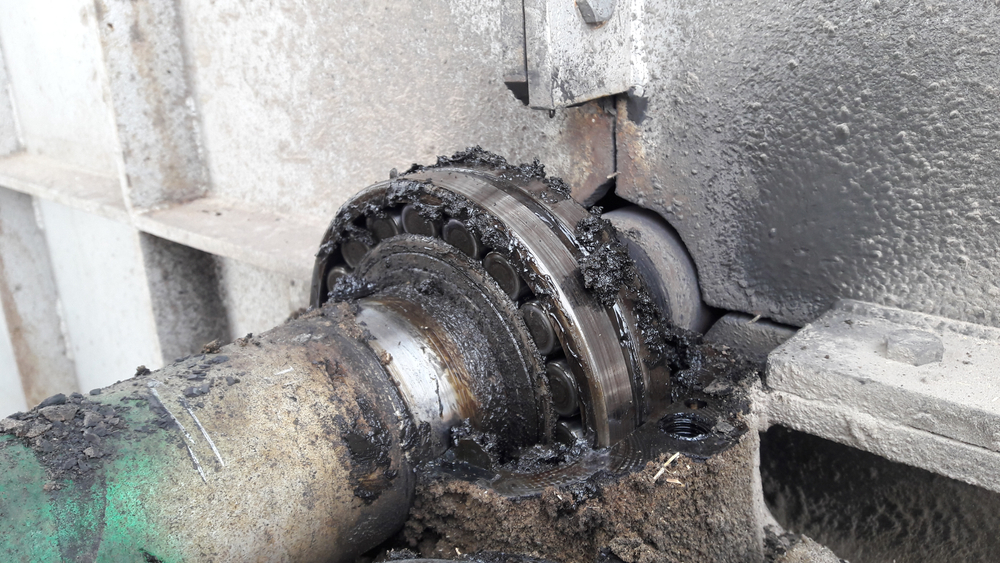
A single grease-related component failure on a haul truck costs far more than the part. In one 50-truck fleet analysed in our whitepaper, The Prevention Paradox, frame component replacements averaged around US$54,000 in direct repair cost and 215 hours (about nine days) of downtime per event. Once lost production is included, the whitepaper’s fleet risk model puts the average total cost per failure at US$172,000. For maintenance supervisors at mining and heavy industrial sites, that number demands attention.
Many of these failures do not start with fatigue, overload or misalignment. They start with lubrication. A 2019 Reliable Media analysis found that 36% of premature bearing failures trace back to poor lubrication. That includes wrong grease types, insufficient volumes, missed intervals and contamination.
This article breaks down the main lubrication-related bearing failure causes, from grease starvation to contamination ingress. You will learn the specific failure modes to watch for, why traditional monitoring methods miss them, and how verified grease delivery changes the equation.
Key Takeaways: Bearing Failure Causes
- Poor lubrication accounts for 36% of premature bearing failures across industrial equipment and fleets, according to a 2019 Reliable Media analysis.
- Under-lubrication, over-lubrication, contamination and grease incompatibility each produce distinct and identifiable damage patterns on bearing surfaces.
- Traditional auto-lube monitoring confirms pump pressure, not whether grease actually reached the bearing at the point of delivery.
- GreaseBoss verifies the exact grease volume delivered to each monitored point, converting assumed lubrication into measured data.
- Bearing failure analysis starts with inspecting raceway surfaces, discolouration and wear paths to trace the root cause.
What Is Bearing Failure Analysis?
Bearing failure analysis is the systematic inspection of a damaged bearing to identify the root cause of its failure. Every failure leaves a unique imprint on the bearing’s raceways, rolling elements and cage. By reading those patterns, your reliability team can trace the problem back to its source and prevent recurrence.
The process typically involves visual inspection of wear paths, surface condition assessment, and correlation with operating data such as load, speed, temperature and lubrication records. Common failure modes include fatigue spalling, abrasive wear, adhesive wear, corrosion, electrical erosion and fracture.
For maintenance supervisors managing fleets of haul trucks, excavators or fixed-plant conveyors, failure analysis is not optional. It is the starting point for every corrective action that keeps your assets running. Without it, you are guessing at the cause and likely repeating the same failure.
Why Is Lubrication the Leading Cause of Bearing Damage?
Bearings depend on a microscopically thin film of lubricant between rolling elements and raceways. When that film breaks down, metal contacts metal. The resulting friction generates heat, accelerates surface fatigue, and can destroy a bearing in hours.
According to Caterpillar, the number one cause of pin failures is a lack of lubrication. Shell PLC estimates that 70% of mechanical failures trace to incorrect lubrication. These figures reflect harsh operating environments where dust, vibration and extreme temperatures constantly degrade lubricant performance.
The challenge is that lubrication failures are silent. A bearing starved of grease does not trigger an alarm. It wears down until it seizes or spalls, often without warning. That invisible progression is what makes lubrication monitoring critical.
How Does Under-Lubrication Damage Bearings?
Under-lubrication occurs when a bearing receives too little grease, or when grease is delivered at intervals too far apart. Without adequate lubricant, the elastohydrodynamic film between rolling elements and raceways collapses. Metal-on-metal contact begins.
The first visible sign is a polished or mirror-like finish on the raceways, where surface asperities have been sheared away. As damage progresses, you will see discolouration from heat, micro-pitting and eventually spalling. Bearings that run under-lubricated also become vulnerable to adhesive wear, where material transfers between the rolling element and raceway surfaces.
In mining operations running CAT 793 or Komatsu 930E haul trucks, under-lubrication of A-Frame bearings, kingpins and hoist cylinders is a persistent risk. Auto-lube systems are supposed to prevent it, but a blocked injector or blown hose downstream of the injector stops grease delivery entirely, and the pump pressure gauge can still read normal.
What Happens When Bearings Are Over-Lubricated?
Over-lubrication is often overlooked because it seems like the safer option. In reality, too much grease creates its own set of problems. Excess grease generates internal friction as the rolling elements continuously push through surplus lubricant. That friction produces heat, which accelerates grease oxidation and shortens lubricant life.
On regreasable bearings, over-lubrication can rupture seals, exposing the bearing internals to contaminants. Grease also acts as an insulator. Too much of it traps heat inside the bearing housing, raising operating temperatures beyond acceptable limits.
The result is the same accelerated wear cycle you see with under-lubrication: thermal degradation of the grease, loss of the lubricant film and premature bearing failure. Planned vs actual grease volume data eliminates the guesswork, showing your team exactly how much grease each point is receiving per cycle.
How Does Grease Contamination Cause Bearing Failure?
Contamination is the silent partner to lubrication failure. When foreign particles such as dust, iron ore fines, water or metal shavings enter the bearing cavity, they mix with the lubricant and create an abrasive slurry. Every rotation of the rolling elements grinds those particles into the raceways, producing indentations, surface pitting and accelerated fatigue.
In mining environments, contamination ingress is relentless. According to an investigation published by The Australian Mining Review, incorrect or insufficient lubrication accounts for more than 45% of bearing failures, with contamination considered the major component of those lubrication problems.
Water contamination is particularly destructive. Even small amounts of moisture alter grease properties, reduce viscosity and promote corrosion on raceway surfaces. In operations where equipment sits idle between shifts, condensation alone can initiate corrosion pitting that leads to premature spalling once the bearing returns to service.
Why Are Incompatible Greases Dangerous for Bearings?
Mixing incompatible greases is one of the most preventable causes of bearing damage, yet it happens regularly on sites where multiple grease types are in use. When greases with different thickener chemistries combine, the mixture can soften, harden or separate. Any of those outcomes compromises the lubricant film.
A softened mixture leaks from the bearing cavity, leaving rolling elements unprotected. A hardened mixture cannot flow into the contact zone. Separated grease releases base oil that drains away, leaving a dry thickener cake with zero lubrication value.
Changes in grease colour, texture or consistency inside the housing indicate incompatibility. GreaseBoss Manual Lubrication Management guides technicians to each RFID-tagged point with its scheduled grease type and records the volume applied, reducing cross-contamination risk.
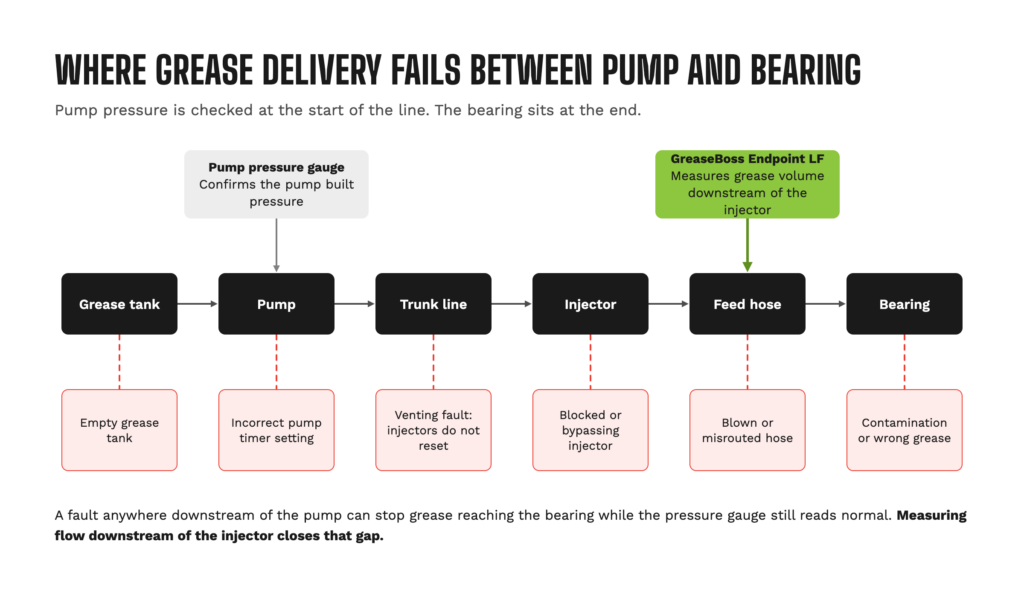
Why Does Pump Pressure Not Confirm Grease Delivery?
Many maintenance teams monitor auto-lube systems by checking pump pressure. If the pump reaches pressure, the assumption is that the machine has been greased. That assumption is wrong.
Pump pressure confirms the pump is generating force. It does not confirm grease has travelled through the trunk line, past the injectors, and arrived at the bearing. A blocked injector, bypassing injector, blown hose or venting issue can prevent delivery while the gauge reads normal.
This gap between assumed and actual greasing is where silent failures begin. GreaseBoss Endpoint LF sensors measure grease flow at the point of delivery, downstream of injectors and distributors, confirming whether grease actually reached the bearing.
How to Identify Lubrication-Related Bearing Damage
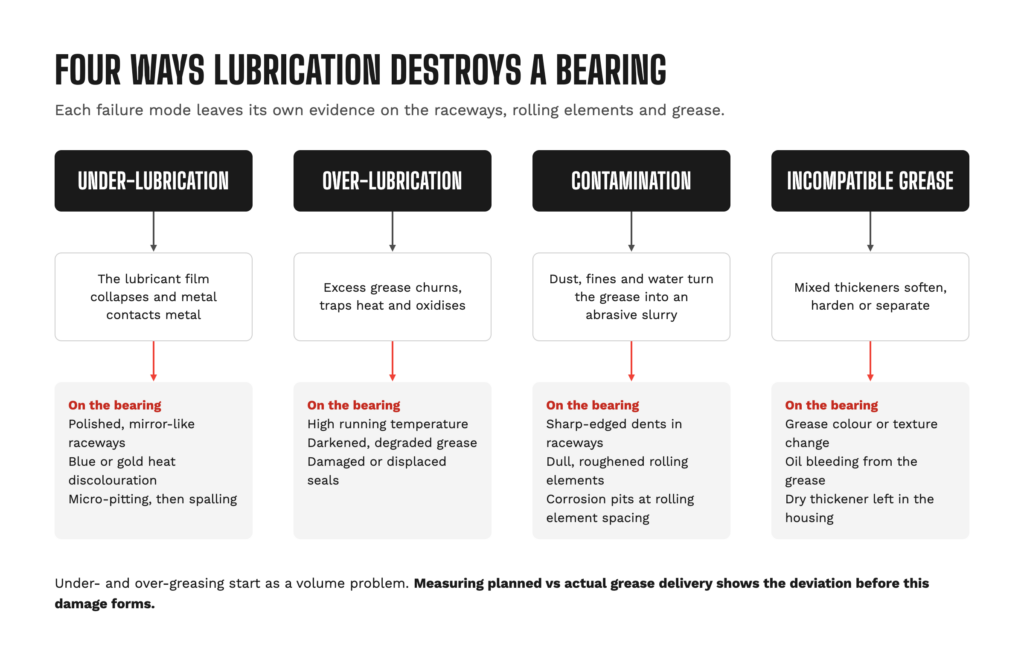
When a failed bearing lands on your workbench, the damage pattern tells you what went wrong. Lubrication-related failures leave distinct signatures that differ from fatigue, misalignment or electrical damage.
Look for these indicators during your inspection:
- Polished or mirror-finish raceways: insufficient lubricant film allowing surface asperity contact
- Blue or gold discolouration on rings and rolling elements: overheating from inadequate or degraded lubrication
- Raceway indentations with sharp edges: hard contaminant particles rolled into the surface
- Dull, roughened surfaces on rolling elements: abrasive wear from contaminated grease
- Grease discolouration or consistency changes inside the housing: possible grease incompatibility or degradation
- Corrosion pitting at rolling element spacing: moisture ingress during standstill periods
Each of these patterns maps to a specific lubrication failure mode. Recording them systematically through your lubrication monitoring program builds the data foundation for corrective and preventive action.
How Does Verified Grease Delivery Prevent Bearing Failures?
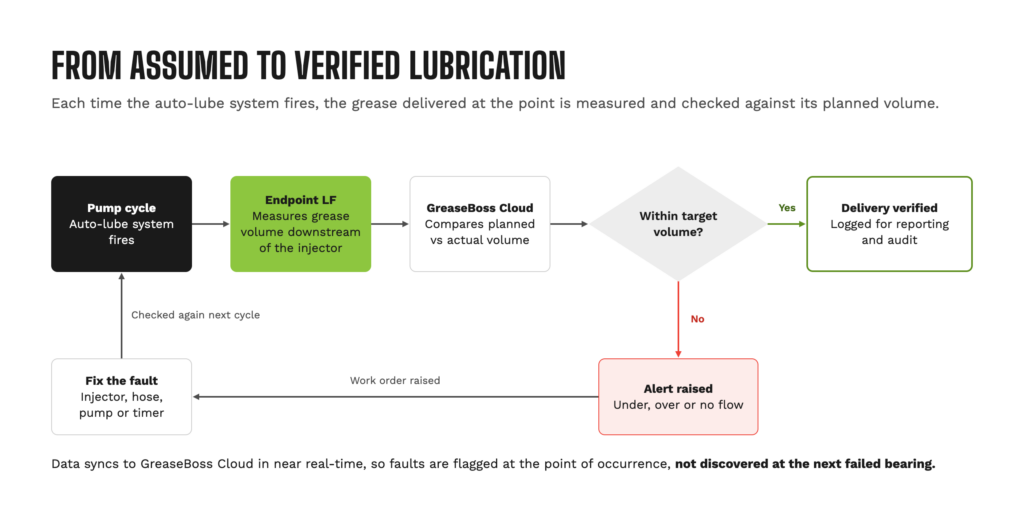
Prevention starts with a fundamental shift: from assumed lubrication to verified lubrication. Traditional approaches rely on pump cycles, pressure readings and visual checks. Those methods tell you the system ran. They do not tell you the bearing received grease.
Verified grease delivery measures the actual volume of lubricant arriving at each monitored grease point, every pump cycle. When the planned volume does not match the actual volume, your maintenance team receives an alert and can raise a work order before the bearing is damaged.
GreaseBoss Critical Point Monitoring compares planned vs actual grease volumes against target volumes set for each point. Faults such as blocked injectors, bypassing injectors, blown hoses, empty grease tanks and incorrect pump timer settings are detected at the point of occurrence. In one haul truck deployment described in The Prevention Paradox [LINK: Prevention Paradox landing page], the system identified two lubrication anomalies within the first week of installation on two trucks. That detection speed is what separates prescriptive maintenance from reactive repair.
What Steps Should Maintenance Teams Take to Reduce Bearing Failures?
Reducing bearing failures from lubrication issues does not require overhauling your entire maintenance program. It requires verifying that your existing lubrication program is actually delivering results at the bearing.
Start with these actions:
- Audit your auto-lube systems for blocked injectors, bypassing injectors, blown hoses and venting issues
- Verify grease type compatibility at every point before relubrication
- Establish planned vs actual grease volume baselines for critical assets
- Install flow-measurement sensors downstream of injectors to confirm delivery
- Review and correct pump timer settings against OEM specification targets
For fleets of heavy mobile equipment or large fixed-plant operations, these steps become practical only when you have data. GreaseBoss Cloud provides your team with centralised visibility over every monitored grease point, with automatic alerts for exceptions and comprehensive reporting by asset.
In Summary: How Lubrication Failures Destroy Bearings and How to Stop Them
Bearing failures from lubrication issues are not random events. They follow predictable patterns: under-lubrication starves the film, over-lubrication generates heat, contamination grinds the surfaces, and incompatible greases break down the lubricant entirely. Each failure mode leaves identifiable evidence on the bearing.
The common thread across all of these is a visibility gap. Maintenance teams have historically assumed that if the pump ran, the bearing was greased. That assumption is where most failures start. Closing that gap with verified, point-of-delivery grease measurement converts reactive bearing replacements into preventable, prescriptive maintenance actions.
FAQs About Bearing Failure Causes
What is the most common cause of industrial bearing failure?
Lubrication problems are among the most common causes. A 2019 Reliable Media analysis attributes 36% of premature bearing failures to poor lubrication. This includes under-lubrication, over-lubrication, contamination and using the wrong grease type for the application.
How can you tell if a bearing failed due to lubrication issues?
Lubrication-related damage shows distinct patterns. Polished raceways indicate insufficient lubricant film. Blue or gold discolouration signals overheating. Indentations with sharp edges point to hard contaminant particles embedded in the grease.
Does pump pressure confirm that a bearing has been greased?
No. Pump pressure confirms the pump generated force, not that grease reached the bearing. Blocked injectors, blown hoses and bypassing injectors can prevent delivery while pressure reads normal. GreaseBoss measures grease flow at the point of delivery to verify actual volumes.
What is the difference between bearing failure analysis and condition monitoring?
Bearing failure analysis examines a damaged bearing after it has failed to identify the root cause. Condition monitoring tracks operating parameters to detect problems before failure occurs. GreaseBoss provides condition monitoring for lubrication by comparing planned vs actual grease delivery every pump cycle.
How does grease contamination lead to bearing damage?
Contaminants like dust, water and metal particles mix with grease and create an abrasive slurry. Each rotation of the rolling elements grinds these particles into the raceways, producing pitting and accelerated fatigue that shortens bearing life.
Can over-lubrication cause bearing failure?
Yes. Excess grease generates friction and heat as rolling elements push through surplus lubricant. That heat degrades the grease, can rupture seals, and exposes the bearing to contaminants. GreaseBoss tracks planned vs actual grease volumes to detect both over-lubrication and under-lubrication.
Which haul truck and excavator grease points are most vulnerable to lubrication failure?
A-Frame bearings, kingpins, hoist cylinders, boom foot pins and slew ring bearings are among the most vulnerable components on haul trucks and excavators. These high-load, high-impact points demand consistent, verified grease delivery to maintain their design life.