
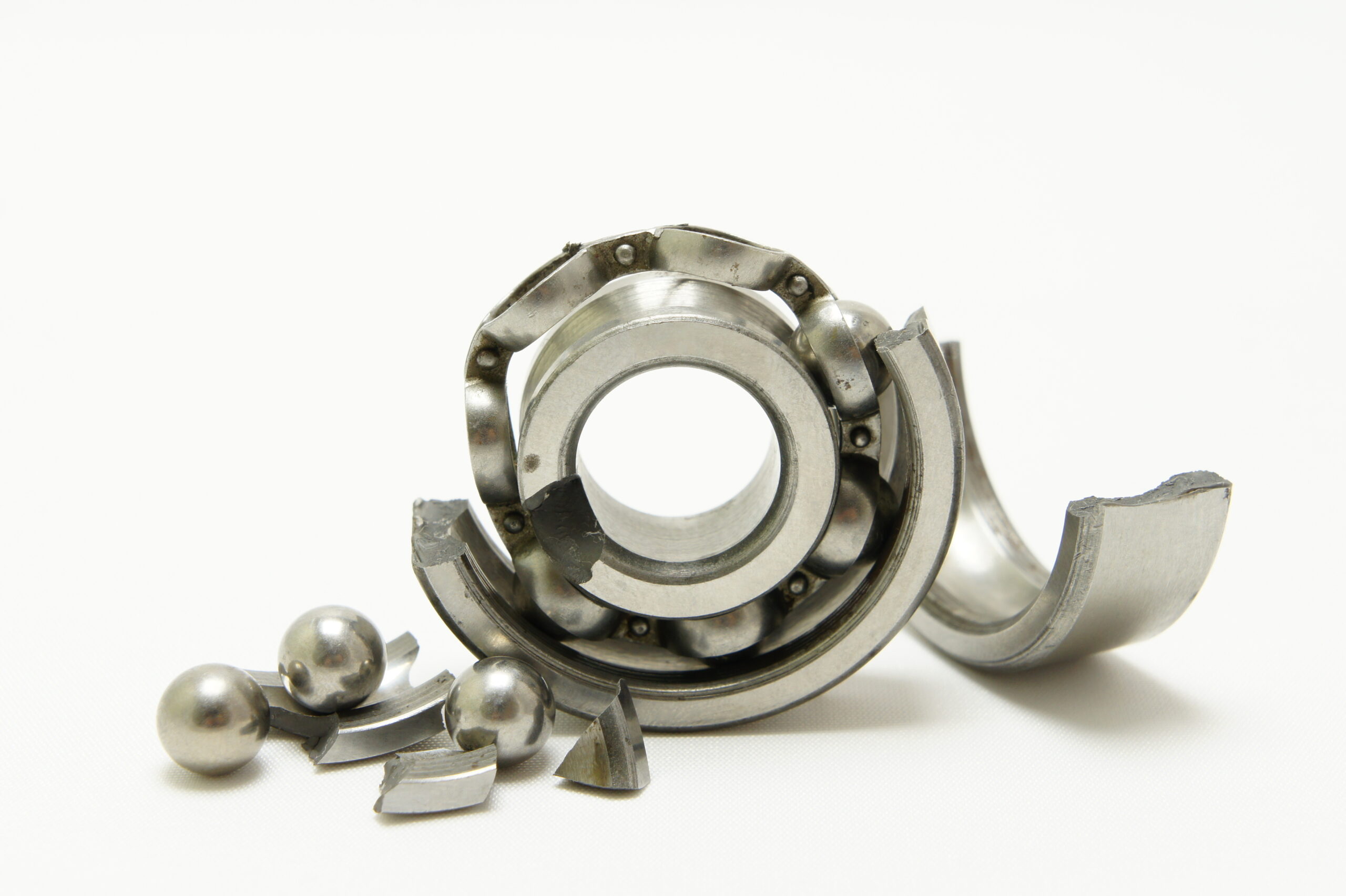
SKF states that 50% of premature bearing failures are attributed to incorrect lubrication. A single bearing failure on a crusher, conveyor or haul truck can halt production for days and cost a site hundreds of thousands of dollars. In mining and quarrying, bearing failure analysis is one of the most valuable disciplines a maintenance team can build. Yet many operations still treat a bearing replacement as routine instead of asking what caused it.
This guide takes a lubrication-first approach to bearing failure analysis in mining and heavy equipment. It covers the root causes of bearing damage, the warning signs before a catastrophic failure, and how to stop the same failure happening again.
Key takeaways
- Lubrication problems cause a large share of premature bearing failures in mining and heavy equipment.
- Bearing failure analysis follows a structured process: document, inspect the grease, map the damage, check fits and alignment, record the root cause.
- Dust, water and metal particles accelerate bearing wear in mine and quarry environments.
- A lube pump reaching pressure does not prove grease reached the bearing.
- Measuring grease delivery at the point of lubrication turns assumed lubrication into verified lubrication.
What Is Bearing Failure Analysis?
Bearing failure analysis is the systematic examination of a failed or damaged bearing to find the root cause of its deterioration. The goal is not just to record what happened, but to understand why, so it does not happen again on the same asset or across the fleet.
In mining, bearings run under heavy loads, high vibration, wide temperature swings and constant exposure to abrasive dust. These conditions speed up every failure mode. A structured analysis separates a bearing that reached the end of its rated life from one that failed early because of a fault you can fix.
The process involves removing the bearing, photographing its condition, examining the raceways and rolling elements, assessing the lubricant and reviewing the operating history. Done consistently, it turns individual breakdowns into fleet-wide prevention data.
Why Does Bearing Failure Analysis Matter for Mining Operations?
A bearing failure costs far more than the replacement part. A seized bearing on a conveyor head pulley, a crusher mainshaft or a haul truck wheel group can stop production across a whole circuit, once parts, labour, crane hire and lost production are counted.
If bearings on one conveyor position fail every eight months, replacing them on a calendar schedule does not solve the problem. Failure analysis shows whether the cause is contamination, the wrong lubricant, misalignment or under-greasing.
That changes the maintenance strategy from reactive replacement to targeted prevention, and it protects component design life across the fleet. It also gives the reliability team the evidence to justify condition monitoring or Critical Point Monitoring.
What Are the Most Common Causes of Bearing Failure?
Bearing failures in mining trace back to a short list of root causes. Investigate each of these during every teardown. For how they play out on haul trucks specifically, see [Causes of Bearing Failure in a Mining Fleet].
Lubrication failure
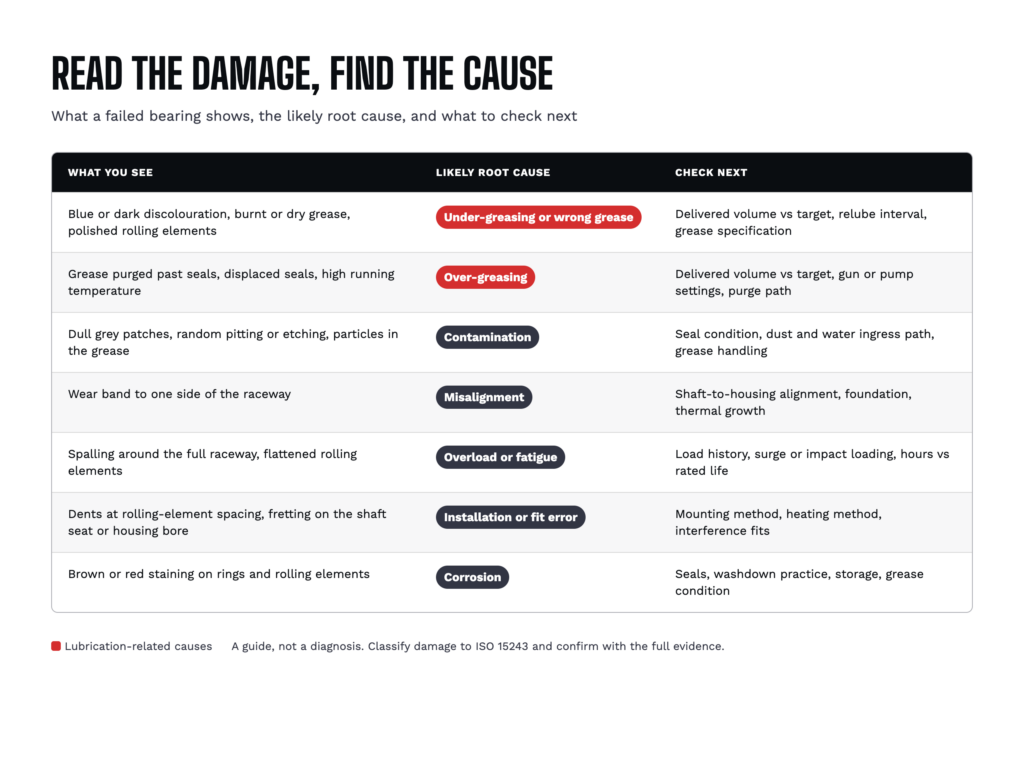
Lubrication failure is the largest single cause of premature bearing damage. It takes three forms: under-greasing, over-greasing and the wrong lubricant. In mining, remote grease points, high ambient temperatures and manual routines that are hard to verify make it worse. On a failed bearing it shows as blue or dark discolouration, burnt grease, polished rolling elements and cage damage.
Contamination
Dust, water, metal particles and process slurry get past damaged or inadequate seals and mix with the grease into an abrasive paste. Fine silica dust in quarries is especially destructive. The damage shows as random pitting, etching and dull grey patches, often with visible particles in the grease.
Misalignment
Misalignment loads one side of the raceway more than the other, leaving a wear band to one side. In fixed plant it comes from thermal growth, foundation settling or poor installation. On mobile equipment, frame flex and structural fatigue shift bearing seats over thousands of hours.
Overloading
Crusher surge loads, impact zones on conveyors and overloaded haul trucks push bearings past their rated load. The result is spalling, flattened rolling elements and heat discolouration, usually spread evenly around the raceway.
Improper installation
Mounting force through the rolling elements causes false brinelling. Heating with an open flame instead of an induction heater can damage the bearing steel. Fits that are too tight remove internal clearance, and fits that are too loose let the ring creep and cause fretting corrosion.
Corrosion
Moisture past the seals, or grease that has lost its corrosion inhibitors, leaves brown or red staining on rings and rolling elements. Even light surface corrosion creates stress points that lead to spalling under load.
How to Recognise the Warning Signs of Bearing Failure
Bearings rarely fail without warning. On a mine site the signs are easy to miss under ambient noise, vibration and heat from surrounding equipment. Knowing what to listen for, measure and inspect gives the team time to act before a failure stops production.
Unusual noise
Grinding or grating points to contamination or metal-to-metal contact. High-pitched squealing usually means not enough grease film. A rhythmic knock that matches shaft speed points to a damaged rolling element or spalled raceway.
Elevated temperature
A failing bearing runs hotter. Regular infrared scans set a baseline. A common rule of thumb is to investigate a rise of 10 to 15°C above baseline that isn’t explained by load or ambient temperature. High temperatures also break down the grease, so the problem compounds.
Increased vibration
Rising vibration in the bearing’s defect frequencies is one of the earliest measurable signs of internal damage. Vibration analysis picks up early spalling and cage damage well before they are audible, so replacements can be planned into a shutdown.
Lubricant degradation
Grease that is dark, smells burnt, contains metal particles or has separated into oil and thickener signals bearing distress. Sampling grease from accessible housings during scheduled maintenance is a cheap early warning.
How to Conduct a Bearing Failure Root-Cause Analysis
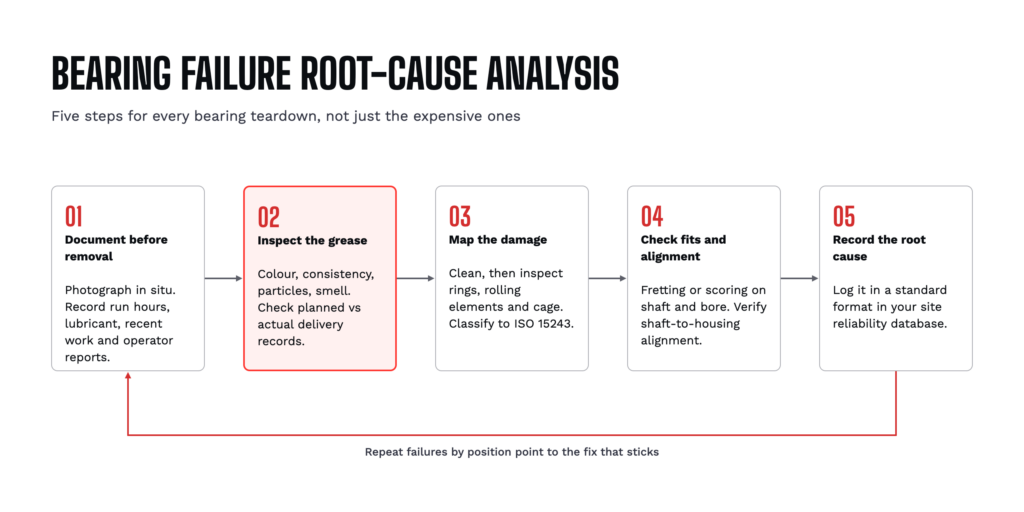
A structured root-cause analysis turns one bearing failure into prevention data for the whole fleet. Follow these five steps for every teardown, not just the expensive ones.
Step 1: Document before removal
Photograph the housing, shaft and surrounding components in place. Record operating hours since installation, the lubricant in use and any recent maintenance. Note whether operators reported noise, heat or vibration before the failure.
Step 2: Inspect the lubricant
Extract and examine the grease before cleaning the bearing. Colour, consistency, particles and smell are all clues. Dark, dry or metallic grease points to lubrication failure. Separated grease suggests thermal breakdown or incompatible greases mixed during relubrication.
This is where planned vs actual lubrication data matters. If your site records grease delivery at the point of lubrication, you can confirm straight away whether the bearing received its target volume on schedule. Without that record, lubrication was assumed, not measured.
Step 3: Examine the bearing surfaces
Clean the bearing and inspect the inner ring, outer ring, rolling elements and cage under good light. Map where the damage sits. Wear around the full raceway suggests overloading or fatigue. Wear to one side suggests misalignment. Random pitting points to contamination.
Classify the damage against ISO 15243, which groups bearing damage into fatigue, wear, corrosion, electrical erosion, plastic deformation, and fracture and cracking. A shared standard keeps findings consistent across the team.
Step 4: Assess the mounting and alignment
Inspect the shaft seat and housing bore for fretting, scoring or dimensional change. Fretting on the shaft means a loose fit let the inner ring creep. Scoring in the housing bore suggests contamination got between the outer ring and the housing. Verify shaft-to-housing alignment with a laser alignment tool or dial indicators.
Step 5: Identify the root cause and record findings
Name the primary failure mode and its root cause, and record it in a standard format in your site’s reliability database. Over time the data shows patterns: positions that fail repeatedly, greases that underperform at certain temperatures, or auto-lube systems that consistently under-deliver.
Why Lubrication Has the Greatest Impact on Bearing Life
The grease film is the only thing separating the rolling elements from the raceway. With an adequate film, a bearing can run for tens of thousands of hours. When the film breaks down, damage starts quickly.
The scale of the job makes this hard in mining. A single haul truck has dozens of grease points, and a crusher and conveyor circuit can have hundreds. Many rely on automatic lubrication systems that pump grease on a timed cycle. The assumption is that if the pump runs, the grease arrives. That assumption fails more often than most sites realise.
Pump pressure does not equal grease delivery.
A blocked or bypassing injector, a blown hose downstream of the injector or a mistuned pump timer can all leave the pump reaching normal pressure while a bearing goes short. A pressure reading confirms the pump. It does not confirm the bearing was greased.
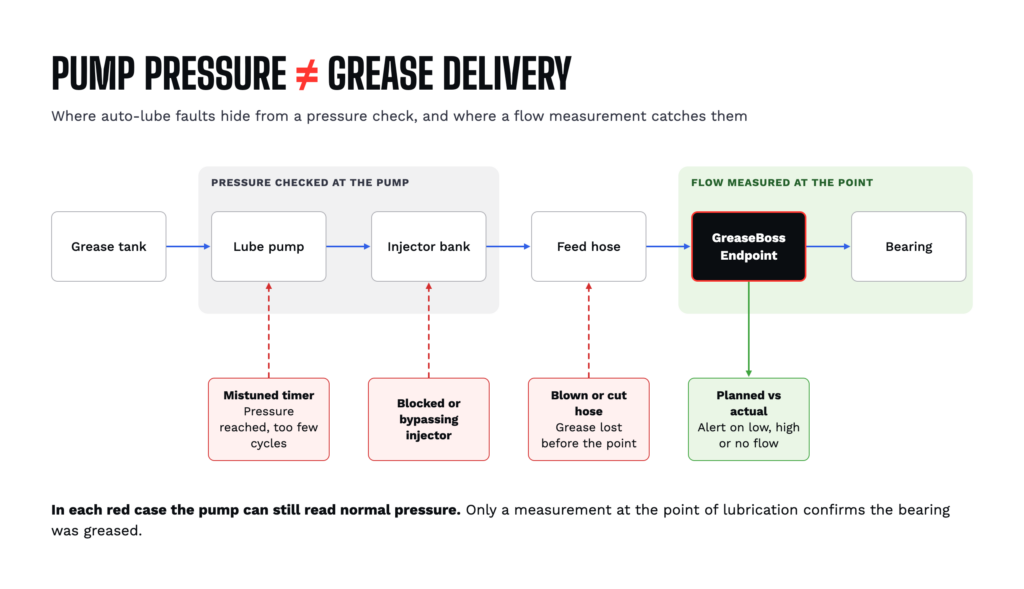
GreaseBoss Critical Point Monitoring closes that gap by measuring grease flow at the point of lubrication. An Endpoint LF, a wireless, battery-powered flow meter, is installed downstream of the injector at each critical grease point. Each time the system pumps, it records the volume delivered. The data passes through a Gateway to GreaseBoss Cloud, which compares planned vs actual volumes against preset targets. When delivery is under, over or nil, the team gets an alert and can raise a work order before bearing damage begins.
How Contamination Accelerates Bearing Wear in Mining
Mines and quarries are some of the harshest contamination environments bearings face. Silica dust from crushing and screening, water from washdown and rain, metal wear particles and process slurry all target bearing housings.
The seal is the first line of defence. Labyrinth and contact seals wear faster on site because of abrasive dust, UV exposure and thermal cycling. Once contaminants get in, they mix with the grease and grind the raceway from inside. They also degrade the grease, reducing its film strength and corrosion protection.
Effective contamination control means specifying sealed bearings where the application allows, upgrading seals on high-exposure positions, using grease to purge contaminants out through the seals, and checking grease condition on scheduled inspections.
What Role Does Over-Greasing Play in Bearing Damage?
Over-greasing is one of the most common and least recognised causes of bearing damage. Adding “a bit extra” to be safe creates its own problems.
Excess grease in the bearing cavity churns on every revolution. That raises operating temperature and breaks the grease down faster. It also builds internal pressure that can push seals out of position, opening a path for contamination.
As a guide, a bearing’s free space is filled to about one-third at initial fill. Relubrication quantities are calculated from bearing size and interval. Either way, it means knowing the target volume per point and controlling what is delivered. A standard grease gun delivers different amounts depending on the operator, the gun and the resistance at the fitting.
For manually greased points, GreaseBoss Manual Lubrication Management removes that guesswork. The Head Unit replaces the hose on a standard grease gun. It confirms the right point by its RFID Grease Tag, measures the grease applied against the target and records the job in GreaseBoss Cloud, so over-greasing and under-greasing patterns show up before they cause damage.
How to Build a Bearing Failure Prevention Strategy
Prevention is not about removing every risk. It is about tackling the highest-impact causes systematically and getting visibility where failures develop silently.
Verify lubrication delivery at the point
The most effective step is moving from assumed to verified lubrication: measuring grease delivery at the bearing, not at the pump. Confirming the right grease, in the right amount, at the right time at every critical point addresses the biggest cause of premature failure.
Standardise failure analysis across the site
Examine and document every bearing removed from service with the same process. Correlating lubrication delivery records with bearing failure history in one place, such as GreaseBoss Cloud, shows which positions and practices need attention.
Upgrade sealing on high-exposure positions
Find the positions most exposed to dust and water: conveyor tail pulleys, crusher bearing housings and anything in a washdown path. Fit sealed or better-protected housed units and keep grease purging through the seals.
Train the team on correct installation
Installation errors are preventable. Train every fitter on induction heating, applying force through the correct ring only, and checking alignment after installation.
Monitor automatic lubrication system health
Don’t rely on pump pressure alone. Blocked injectors and blown hoses downstream of the injector can show normal pump pressure while a bearing gets no grease. Critical Point Monitoring measures flow downstream of the injector to confirm delivery and surface these faults early.
What Equipment and Tools Support Bearing Failure Analysis?
Physical inspection
- Good lighting and magnification for raceway surfaces
- Digital camera for before-and-after records
- Cleaning solvent (mineral turpentine or kerosene) and lint-free cloths
- Soft brushes for removing hardened grease
- Feeler gauges for internal clearance and end float
- Infrared thermometer for temperature baselines
Alignment and mounting
- Laser alignment system or dial indicators
- Induction bearing heater
- Hydraulic bearing puller
- Mounting sleeves matched to the ring being pressed
Data and monitoring
- Vibration analysis equipment
- Grease sampling kits
- A digital lubrication management system that tracks planned vs actual grease delivery across the fleet
How Does Bearing Failure Analysis Differ Between Fixed Plant and Mobile Equipment?
The analysis process is the same. What differs is the operating conditions, access and consequences.
Fixed-plant bearings
Conveyors, crushers, screens and mills run at fairly steady speeds and loads. Bearing positions are stationary and accessible, so vibration sensors, temperature probes and preventive maintenance schedules apply cleanly. Analysis benefits from stable operating data that can be matched to lubrication delivery records.
Mobile equipment bearings
Haul trucks, excavators, loaders and dozers put bearings through variable loads, shock loading, frame flex and heavy vibration. Grease points are often hard to reach, and manual greasing depends on operator discipline and route knowledge that staff turnover disrupts. Analysis here must check whether the greasing method, manual or automatic, actually reached the failed position.
In Conclusion: Turn Every Bearing Failure into Prevention Data
Bearing failure in mining is not inevitable. Most premature failures trace back to lubrication, contamination, misalignment and installation errors, and every one of them can be corrected.
Structured failure analysis turns costly surprises into prevention intelligence. Document every failure, examine the grease, map the damage and record the root cause, and you build a data set that drives improvement across the fleet.
The biggest single step is closing the lubrication visibility gap. When delivery is assumed, failures develop unseen. When it is measured at the point of lubrication, your team knows critical assets are greased correctly, and can act before damage begins.
Lubricate with confidence.
FAQs About Bearing Failure Analysis in Mining Equipment
What is the most common cause of bearing failure in mining?
Lubrication problems are the leading cause of premature bearing failure in mining equipment. Under-greasing, over-greasing and the wrong grease all weaken the film between the rolling elements and the raceway. Contamination is the next most common cause on dusty and wet sites.
How do you identify contamination damage on a failed bearing?
Look for random pitting, etching and dull grey patches across the raceways. The grease often holds visible particles or has separated into oil and thickener. In quarries, fine silica dust is the most common contaminant.
Why does pump pressure not confirm grease delivery to the bearing?
An auto-lube pump can reach normal pressure even when grease isn’t reaching a bearing. A blocked or bypassing injector, or a blown hose downstream of the injector, cuts off that point without affecting the pressure reading. GreaseBoss Endpoints measure grease flow downstream of the injector to confirm what was actually delivered.
What is the difference between over-greasing and under-greasing damage?
Under-greasing causes metal-to-metal contact, heat and blue or dark discolouration. Over-greasing causes churning heat, grease breakdown and displaced seals. Both shorten bearing life. Comparing planned vs actual grease volumes, as GreaseBoss Cloud does, shows both patterns before damage occurs.
How often should bearings be inspected in a mining operation?
A common approach is daily operator checks for noise and heat, weekly infrared and vibration spot-checks on critical positions, and monthly grease sampling, clearance checks and alignment verification. Adjust intervals to each asset’s criticality and history.
Can bearing failure analysis reduce maintenance costs?
Yes. Finding the root cause of repeat failures lets you fix the cause instead of replacing the same bearing again. Over time that cuts unplanned downtime and lowers the total cost of ownership of bearings across the fleet.