
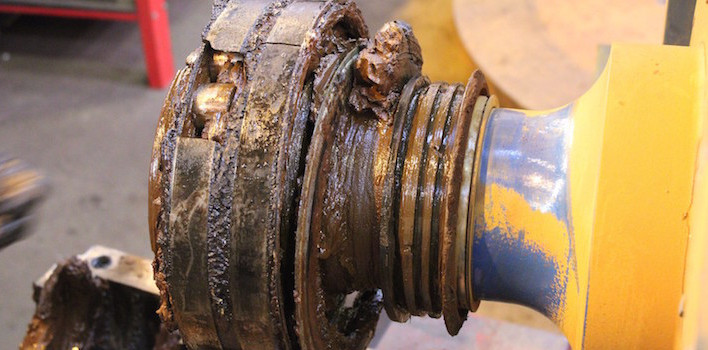
Conveyor pulley bearing failure can stop an entire production line. In quarry, mining and processing plant operations, that means lost tonnes per hour, emergency repairs and a knock-on effect across the schedule. Many of these failures trace back to the same root cause: lubrication that was assumed rather than verified.
This guide explains how lubrication faults lead to pulley bearing seizure, belt misalignment and drive breakdowns. It covers the fault points in auto-lube systems, the warning signs to watch for and a structured way to investigate a failure. It closes with how to build a lubrication programme that confirms grease actually reached each bearing.
Key takeaways
- Under-lubrication is a major cause of conveyor pulley bearing failure, belt mistracking and drive pulley stoppages.
- Pump pressure does not confirm grease reached the bearing. Only delivery measured at the point of lubrication does.
- Blocked or bypassing injectors, blown hoses, empty tanks, incorrect pump timers and venting faults all cause under-greasing.
- GreaseBoss Critical Point Monitoring measures grease volume downstream of the injector and compares planned vs actual delivery for each monitored point.
- Linking lubrication data to failure history moves maintenance from reactive repairs to prescriptive, evidence-based work.
Why lubrication drives conveyor pulley bearing failure
A conveyor depends on dozens of grease points across head, tail, drive and take-up pulleys. Each bearing needs a specific grease, in a specific volume, at a specific interval. When any one of those drifts, the bearing starts accumulating damage.
On conveyors, under-lubrication follows a predictable sequence. Friction rises, operating temperature climbs, heat degrades the remaining grease and the bearing moves towards seizure.
The problem is that this progression is silent. A pulley bearing running hotter than its neighbour rarely triggers an alarm. A system with a blocked injector still shows pressure at the pump, and the conveyor keeps running until the bearing gives out.
Where conveyor auto-lube systems fail silently
Most conveyor lubrication faults sit between the pump and the bearing. Each one cuts grease delivery while the rest of the system keeps cycling.
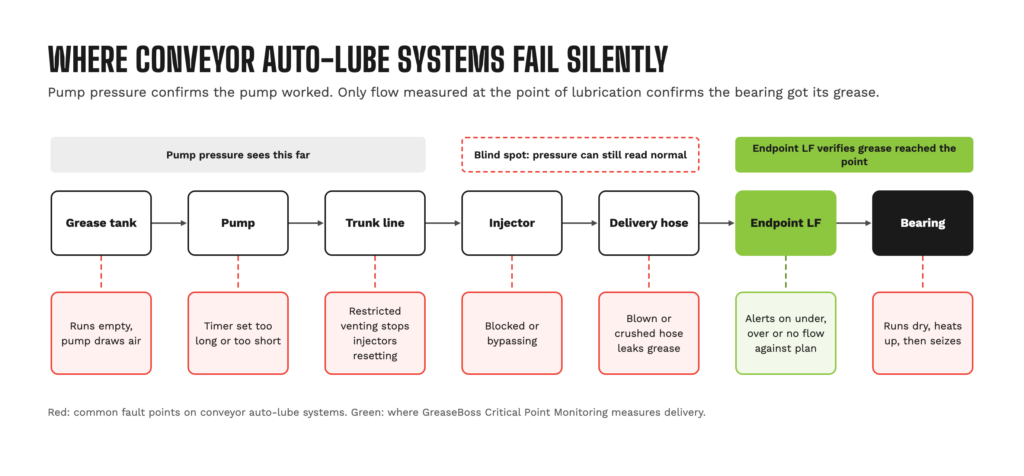
- Empty grease tank. The pump draws air instead of grease, and air pockets disrupt delivery to every downstream point.
- Incorrect pump timer settings. Too infrequent and bearings are under-greased. Too aggressive and over-greasing damages seals and adds heat. Settings often drift after pump replacements or control panel changes.
- Venting faults. If the system can’t vent, injectors can’t fully reset, so each cycle delivers a little less than planned.
- Blocked injectors. Contamination or dried grease stops the injector delivering to its bearing, while the pump still reaches pressure.
- Bypassing injectors. The injector cycles but grease doesn’t move forward to the bearing. The cycle count looks normal.
- Blown or crushed hoses. Vibration, abrasion and material contact damage hoses between the injector and the bearing, and grease leaks out before it arrives.
For a step-by-step guide to finding each fault on site, see How to Troubleshoot Auto Lube Failures in 4 Steps.
Why pump pressure does not confirm grease delivery
Many sites treat pump pressure as proof that the auto-lube system is working. It isn’t. Pressure confirms the pump built force. It does not confirm grease passed through each injector, along each hose and into the bearing housing in the right volume.
A blocked injector, a bypassing injector and a blown hose can all go unseen at the pump. Measuring flow at the point of lubrication is what turns an assumption into evidence.
How lubrication failure causes belt misalignment
Belt misalignment is visible. Its root cause often isn’t. When a pulley bearing is under-greased, friction builds unevenly across the assembly, the pulley drags on one side and the belt is pulled off its path.
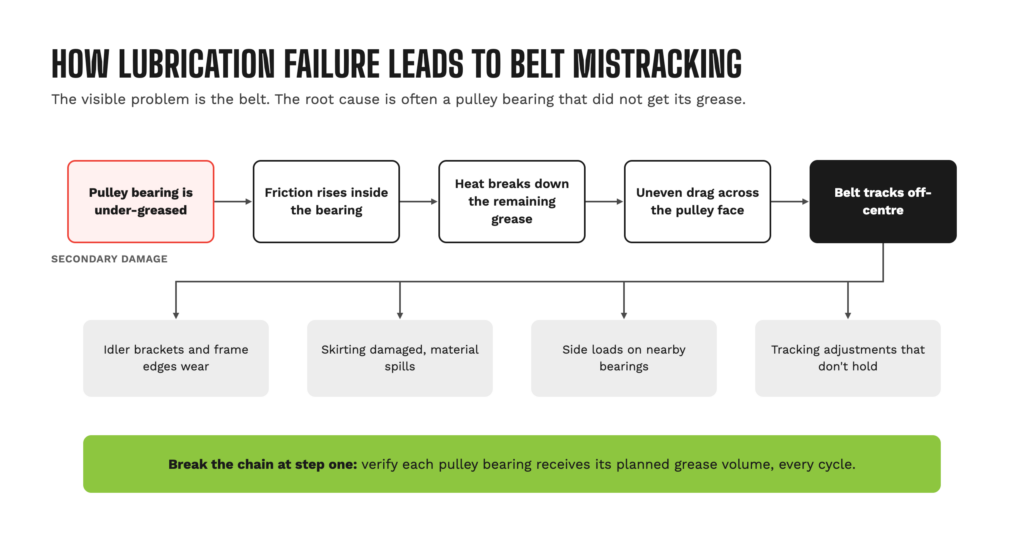
A mistracking belt loads one edge of the frame harder than the other. It wears idler brackets, damages skirting, spills material and puts side loads on nearby bearings that weren’t designed for them. Trade publication Rock to Road also links worn or seized conveyor bearings to roller misalignment, premature belt wear and higher power draw.
If a belt keeps tracking off-centre after adjustment, check the pulley bearings. Idler adjustments won’t correct drag from a bearing that isn’t getting its grease.
How lubrication failure affects conveyor drive components
The drive train carries the highest consequence on a conveyor. Not every part of it is lubricated the same way, so it pays to know which bearings are grease-fed.
Drive pulley bearings
The drive pulley transmits all motor torque to the belt. Its bearings carry belt tension plus the load of the material. Under-greasing here leads to a fast temperature rise, and a seized drive pulley bearing stops the belt with no way to bypass it. These are grease-fed and a priority for verified delivery.
Motor bearings
Motor bearings run at high speed and generate heat under load. Where they are regreasable, missed replenishment breaks down the grease film, followed by noise, vibration, rising current draw and eventual seizure. Many motor bearings are sealed for life, though, and need no regreasing. Check the motor data plate or OEM manual before adding them to a greasing schedule.
Gearbox bearings
Most conveyor gearboxes are oil-lubricated. Low oil level, contaminated oil, the wrong viscosity and worn seals all shorten gearbox bearing life, and abrasive dust speeds up seal wear. Watch for whining or rumbling, metal particles in the oil, leaks or backlash that affects belt speed. Gearbox oil condition sits outside grease delivery monitoring and is best covered by oil analysis.
What are the warning signs of conveyor lubrication failure?
Most lubrication-related failures give early signals. During a busy shift, they can look like normal wear.
- Hot bearing housings. A housing running consistently hotter than comparable bearings on the same conveyor points to grease breakdown or low volume. Infrared or thermal camera checks on walkarounds catch this early.
- Abnormal noise. Grinding, rumbling, squealing or knocking from pulleys or drive components signals metal-to-metal contact or contamination. Plant noise masks it, so listen at close range.
- Recurring belt mistracking. A belt that keeps moving off-centre despite adjustment often has a pulley bearing with uneven drag.
- Rising motor current. Higher amperage than baseline can mean drag building from poorly lubricated pulley bearings or seized idlers.
- Grease leakage or contamination. Grease weeping from housings, discoloured grease at seals or dust-caked fittings point to seal damage or over-greasing.
How to investigate a conveyor pulley bearing failure
Replacing the bearing without finding the cause only resets the clock to the next failure. Start at the failed bearing and work back along the grease path.
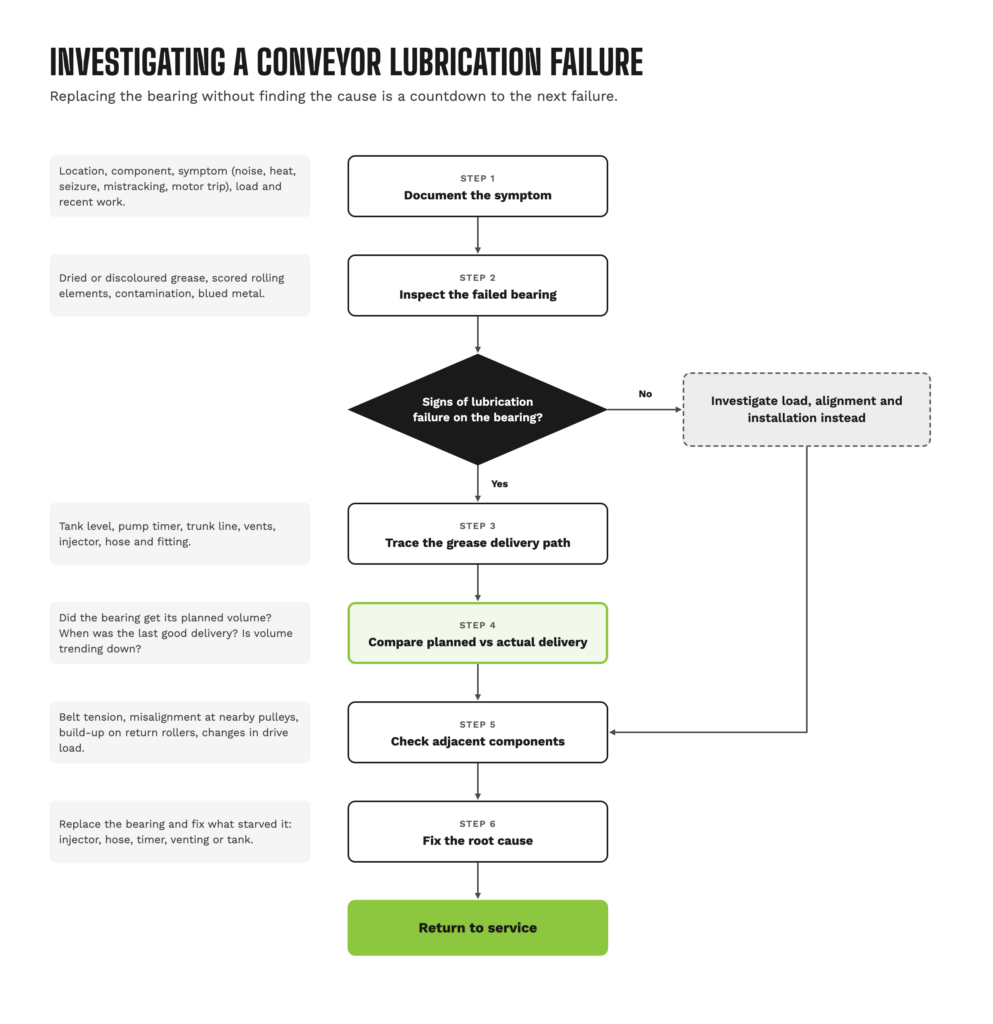
- Document the symptom. Record the location, component and symptom (noise, heat, seizure, mistracking or motor trip). Note the load, ambient temperature and any recent maintenance.
- Inspect the failed bearing. Look for dried or discoloured grease, scored rolling elements, contamination in the housing or blued metal. These separate a lubrication failure from a load or alignment problem. If there are no signs of lubrication failure, investigate load, alignment and installation, then go to step 5.
- Trace the grease delivery path. Follow it from the tank and pump, along the trunk line, through the injector and hose to the fitting. Check tank level, timer settings, vents, injectors and hoses.
- Compare planned vs actual delivery. If the point is monitored, pull its data. Did the bearing get its scheduled volume? When was the last good delivery? Is volume trending down?
- Check adjacent components. Belt tension, misalignment at nearby pulleys, build-up on return rollers or a change in drive load can all contribute.
- Fix the root cause before returning to service. Replace the bearing, then fix what starved it: clean or replace the injector, replace and reroute the hose, or correct the timer, venting or tank.
Building a verified conveyor lubrication programme
A schedule pinned to the workshop wall tells you what should happen. A verified programme confirms the right grease reached the right bearing, in the right amount, at the right time.
Define OEM-based specifications for every point
Start with the manufacturer’s grease type, volume per point and relubrication interval. Map every grease-fed pulley, take-up and regreasable motor bearing to a documented schedule. This is the planned baseline that actual delivery is measured against.
Auto-lube points: verify delivery with Critical Point Monitoring
Traditional monitoring stops at the pump. GreaseBoss Critical Point Monitoring extends it to the bearing. A GreaseBoss Endpoint LF installed downstream of the injector measures the grease volume delivered each time the system pumps. Data passes through a Gateway to GreaseCloud, which compares it against the planned volume and sends near real-time alerts for under-greasing, over-greasing or no flow.
On a Tier 1 gold mine’s SAG mill, this approach surfaced three faults in the first three months
- The trunnion pump was delivering 1.20 g/hr against a planned 9.93 g/hr, only 12% of target.
- Both feed end bearings received virtually no grease for a week.
- Persistently low and declining volumes at the drive end pinion flagged early injector failure, and the site raised a work order to replace it.
The same fault types occur on conveyor auto-lube systems.
Manually greased points: Manual Lubrication Management
Many conveyor bearings are greased by hand on a route. GreaseBoss Manual Lubrication Management covers these. A Head Unit replaces the hose on a standard grease gun and RFID Grease Tags are fitted at each point. The Head Unit guides the technician point by point, confirms the right point, measures the grease applied and records completion in GreaseCloud.
Use lubrication data for prescriptive maintenance
Once delivery data is digital, it becomes a planning tool. Declining volumes, repeat injector faults or missed manual points let supervisors schedule work on evidence rather than calendar intervals alone. The team works on what the data says needs attention.
Which conveyor components to prioritise
Not every bearing carries the same risk. Verify delivery first where a failure costs the most.
- Head and tail pulley bearings. They carry the highest belt tension and control tracking. A seized head pulley bearing stops the conveyor. A struggling tail pulley bearing drives mistracking and belt wear.
- Drive pulley bearings. All motive force passes through them, and a failure stops the whole line.
- Take-up pulley bearings. Friction or seizure here makes belt tension inconsistent, leading to slippage and mistracking.
- Idlers. Most are sealed for life rather than regreased, so they aren’t a greasing target. Seized idlers still add belt drag and motor load, so include them in inspections.
The cost case rests on failures avoided. The bearing itself is a small part of the cost. A pulley seizure on a conveyor feeding the primary crusher idles the crusher, queues haul trucks and stops downstream processing.
Conclusion
Conveyor lubrication failures follow identifiable patterns: blocked or bypassing injectors, blown hoses, empty tanks, incorrect pump timers and venting faults. Each is detectable and preventable.
What lets them cause breakdowns is a visibility gap. If pump pressure is taken as proof, faults build up unseen. Verifying delivery at the bearing against the planned specification exposes them before the bearing is damaged.
For maintenance supervisors in quarry, mining and processing plants, the steps are:
- Map every grease-fed conveyor point.
- Set the OEM-based greasing specification for each.
- Verify delivery at the point of lubrication.
- Act on the data before bearings are damaged.
Eliminate downtime with verified greasing. Reach out to a GreaseBoss expert.
FAQs about conveyor pulley bearing failure
What is the most common cause of conveyor pulley bearing failure?
Inadequate or incorrect lubrication is a major cause. When grease doesn’t reach the bearing in the right volume at the right interval, friction and temperature rise and the bearing moves towards seizure. Contamination, overload and misalignment also contribute.
How does lubrication failure cause belt misalignment?
An under-greased pulley bearing drags unevenly across the pulley face, which pulls the belt off-centre. Verifying that each pulley bearing receives its planned grease volume keeps the pulley running true.
Can pump pressure confirm that grease reached the bearing?
No. Pump pressure confirms the pump built force, not that grease arrived. Blocked injectors, bypassing injectors and blown hoses can all go unseen at the pump. Measuring flow at the point of lubrication is the reliable check.
Which conveyor components should be prioritised for lubrication monitoring?
Grease-fed head, tail, drive and take-up pulley bearings carry the highest failure consequence. GreaseBoss Critical Point Monitoring provides planned vs actual grease data for each monitored point. Gearboxes are usually oil-lubricated, and many motor bearings are sealed for life.
How does GreaseBoss detect conveyor lubrication faults?
A GreaseBoss Endpoint installed downstream of the injector measures the grease volume delivered each time the system pumps. GreaseCloud compares it against the planned volume and sends near real-time alerts when delivery is out of specification.
How quickly can lubrication faults be detected with monitoring?
It depends on the fault and the greasing interval. On a Tier 1 gold mine’s SAG mill, Critical Point Monitoring found mistimed pumping, severe under-greasing and a failing injector in the first three months, so the site could act before a failure.